
The Archontic Worldview
"The Nostrum is Complete"

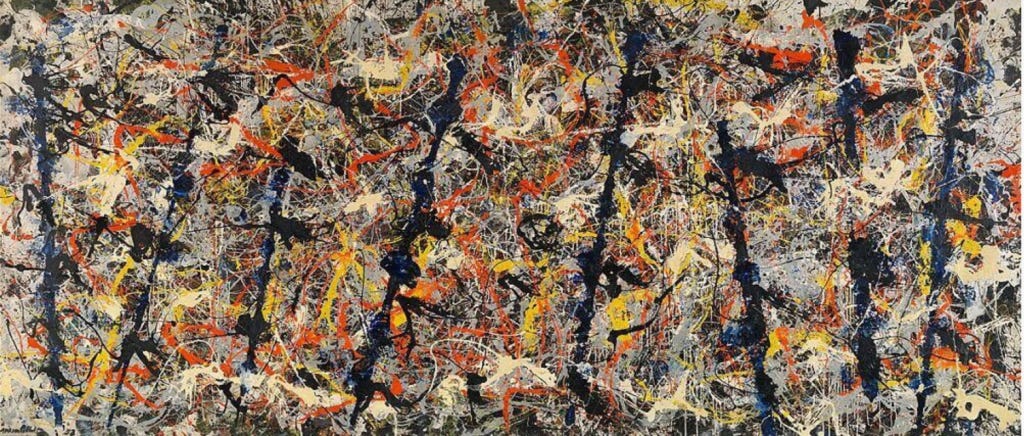
In Jackson Pollock’s Blue Poles, the eye first seizes on the eight vertical beams that stake their claim across the canvas, but it is the ocean of dripped, looping paint— fractal, recursive, unnervingly alive — that will not release the gaze. Something similar has happened in our theology.
We have been taught to orient ourselves by the moral poles of a mythic battlefield (God versus Satan, good versus evil) driven like blue stakes into what is assumed to be a single, divinely ordered creation.
Yet beneath those poles there seethes another pattern: a cosmos whose very structure is chaotic, derivative, and deceptive, the handiwork not of the unspeakable Monad but of a lesser craftsman and his Archons.
The question is not which side of the poles Christ blesses, but whether his own teaching belongs to those poles at all — or whether, in its fullness, it exposes the entire painted field as a prison matrix and invites us into a higher order of reality.
The “beginning of the end” of the Judeo-Christian Era’s omega coincided with the diminishing chaos from two world wars. The subsiding chaos of the mid-1940s presaged a return to order. Not to the old order, but to an interregnum that has lasted for most of a century and has now entered its climactic stage: the Nostrum, our term for the present global interregnum of crafted instability.
Argument for God the Father of Jesus vs. the Old Testament Demiurge
From here, the argument presses beyond aesthetics into theology: the way we “see” a Pollock and the way we “see” the world rise from the same hidden assumptions about what counts as order, what counts as chaos, and who, if anyone, stands behind the whole.
If Blue Poles tempts us first to trust the obvious verticals, it also forces us, on longer viewing, to admit that the painting’s true life, and its true disturbance, resides in the restless field the poles neither explain nor master.
In the same way, we will argue, the inherited God‑versus‑Satan narrative gives us bold, comforting lines inside a cosmos taken for granted as given and good, while the teaching of Jesus, in its fullness, drives our gaze down into the very fabric of that cosmos and quietly announces: the one who fashioned this is not my Father.
The thesis of this essay is that the familiar “good God versus evil Satan” worldview and the Gnostic Monad‑versus‑Demiurge worldview are not two moral interpretations of a shared reality, but two incompatible fractal logics for the structure of reality itself, and that Jesus, read attentively and without the later harmonizing gloss, stands decisively with the latter.
By “fractal logic” I mean the deep pattern that repeats at every scale of a worldview: how it explains God, matter, law, history, and the self in the same basic shape.
If Jesus stands with the Monad against the cosmic craftsman, then what we call “Christianity” has, for nearly two millennia, mistaken the warden for the Father and the prison for the world to come.
The first worldview assumes a single, divinely willed cosmos in which a personal rebel disrupts an otherwise sound creation. It is a story of insurrection in a legitimate kingdom; the blue poles are primary, and the chaos behind them is merely the mess of history.
The second worldview sees the apparent order of the cosmos itself as the problem: a self‑similar pattern of ignorance and violence generated by a lower craftsman, the Demiurge, who mistakes his derivative work for the whole of being.
In such a universe, the difference between “God vs Satan” and “Monad vs Demiurge” is not merely a matter of doctrinal emphasis. It is analogous to the difference between reading Blue Poles as an impressive assertion of form over chaos, and reading it as a revelation that form and chaos belong to the same uneasy, unstable order. We explicated this argument elsewhere in our Setian Cosmology project.
The mythic moral story reassures us that, despite appearances, the world remains the estate of a good householder temporarily troubled by a criminal intruder. The Gnostic–Marcionite teaching insists that the estate itself is improperly built, that its walls lean, its rooms crush their inhabitants, and its law books are part of the problem.
When we listen to Jesus with this rivalry in mind, his words begin to fall into place in a fashion far less congenial to the inherited myth. He speaks of a Father whom the “world” does not know, as if the reigning religious and cosmic order had never truly heard the name of the One True God he represents.
Understood this way, Jesus’ language about “the ruler of this world” being driven out or about his kingdom being “not of this world” is not mere spiritualization of politics. It is ontological disclosure: the admission that the present cosmic order, its gods, laws, and rulers, is under an alien administration, and that his Father’s reign does not, indeed cannot, arise from within that order at all.
He calls blessed those whom the prevailing moral poles mark as cursed: the poor, the impure, the enemy, the outsider. He relativizes institutions that the craftsman’s regime treats as sacred and absolute: Sabbath, sacrifice, blood‑line, and temple. He does so not by refining their logic, but by quietly stepping outside it, saying in effect, “This is not how my Father measures reality.”
Such moves make sense if Jesus arrives as the final envoy of the householder, tightening discipline. They make much more sense, however, if he comes from beyond the house to announce an evacuation.
When this evacuation is complete, so too will the Nostrum be complete. The phrase “The Nostrum is Complete” came to me in a hypnagogic state. This describes a threshold state of liminality; the betwixt and between “space” where the conscious mind's lack of ‘editing’ often yields unique insights and creative breakthroughs.
In narrative terms, then, this essay contends that Jesus is not the last prophet of the ignorant cosmic craftsman who believes himself to be the only god, but the first clear herald of Jesus’ unknown, ineffable Father.
The Demiurge craftsman, on the other hand, is a shaper and arranger, not a creator in the fullest sense; he works with what he does not understand, piling structure upon structure, law upon law, distinction upon distinction, until the world resembles a Pollock canvas overrun with poles, rules, boundaries, and enforcements driven into a field they cannot redeem.
Jesus’ proclamation does not crown this project. Rather, it exposes its limits. His refusal of retaliatory violence, his forgiveness of enemies, his disregard for inherited purity codes, his insistence that the Father sends generosity without regard to merit all read like the voice of a higher order intruding into a closed, recursive system that can only think in terms of debt and payback, sin and sacrifice, reward and punishment.
This recursive system is, in fact, a prison designed to keep humanity in the same ignorant fog as the Demiurge and his Archontic jailers. It is designed to prevent the soul’s “awakening” to its Divine Spark. This spark is seen as a trapped piece of light needing to be awakened to return to its divine source, representing the true, higher self within.
The heart of our thesis is therefore stark: the mythic God‑versus‑Satan story, for all its power, is itself one of the craftsman’s poles, a way of stabilizing a defective world by dramatizing its conflicts and assigning us roles within them.
Jesus’ teaching, when not forced back into that script, points instead to a rupture at the level of being: this whole painted field, poles and all, is not the final measure of reality, and the One he calls Father neither authored its violence nor requires its sacrifices.
The “good news” is not that the craftsman has finally found a better way to manage his estate, but that his estate is not the only world, and that the true God has come, in person, to lead prisoners out of a beautiful, terrifying painting that was never meant to be their home.
If the cosmos itself is a defective pattern generated by a lesser craftsman, then we should expect history to move not simply from “bad” to “better,” but from one regime of deception to another, each promising order after chaos.
The period from the mid‑twentieth century to the present, the interregnum we call the Nostrum, can be read as the final stabilization of the craftsman’s estate: the last, polished version of a prison that now threatens to seal itself forever.
If this alternative reading of Jesus has merit, modern history delivered an unexpected catalyst when suppressed texts re-entered public consciousness.
The Beginning of the End Times
Both the Nag Hammadi Gnostic Library (1945) and Dead Sea Scrolls (1947) were discovered within living memory. The Gnostic Library includes thirteen manuscripts. These are ancient, ancient bound codices resembling early books. These codices contain numerous individual texts or treatises.
One of the Nag Hammadi texts, Hypostasis of the Archons, describes them as having bodies that are both female and male (androgynous), and faces like those of beasts. Archons are presented as agents and the cosmic jailers of the Demiurge, a lower or false god, also known as Yahweh, who mistakenly or ignorantly believes himself to be the ultimate god.
Hypostasis of the Archons details the Archons’ role in the material world: how they incite passions in humans and teach idolatry and sacrifices to enslave individuals and keep them ignorant.
What matters for our purposes is that Hypostasis of the Archons preserves, in mythic form, the same structure we have seen in Jesus’ teaching: a cosmos fabricated by ignorant rulers, human beings as prisoners whose true origin lies beyond that cosmos, and whose liberation is not gained through appeasing the rulers but through awakening to the reality of their fraud.
The reason that many have never heard of these ancient texts is that they were marginalized, condemned, and in many cases destroyed as heretical. The Nag Hammadi library survived precisely because it was providentially hidden away rather than surrendered to the ecclesiastical fires that destroyed the Library of Alexandria.
Paradigms and Worldviews
In this essay we assert that consciousness, and our perception of reality, are also fractalized constructs. The same pattern that governs a civilization’s cosmology governs its science, its politics, and its ethics. Accordingly, if the underlying pattern is altered, every domain begins to reconfigure in the same new shape.
In states of higher consciousness or spiritual awareness, worldviews tend to ‘fractalize.’ Their underlying pattern starts to appear across multiple traditions, making it both possible and necessary to syncretize what once seemed incompatible belief systems.
In other words, it is possible, indeed even desirable, to regard similar, and even contradictory positions, as true. In “The Structure of Scientific Revolutions,” Thomas Kuhn discusses the relationship between paradigm shifts and worldviews. He notes that paradigm shifts are all encompassing, featuring scientific, political, and spiritual dimensions.
Scientific revolutions occur when anomalies accumulate within the existing paradigm, leading to a crisis and ultimately a shift to a new paradigm and a new worldview.
One’s personal worldview is thus a comprehensive system that integrates philosophy, religion, ethics, science, and cultural beliefs to address fundamental questions about life, existence, and human purpose.
Accordingly, when this framework becomes frayed and threatened by paradigm shifts, it bobs and drifts in chaotic and divisive fashion. For example, the now‑familiar contrast between the ‘blue‑pilled’ and the ‘red‑pilled’ symbolizes the victims and the would‑be heroes of the Matrix.
Individuals who are ‘blue‑pilled’ remain comfortably unaware of deeper realities. They prefer the safety of familiar beliefs and established norms, avoiding disruptive truths or challenging perspectives. Their worldview is shaped by a desire for stability and reassurance, even when this requires accepting illusions or half-truths.
In contrast, ‘red‑pilled’ individuals have awakened to a deeper understanding, often described as gnosis or enlightenment. They are driven by curiosity and a willingness to question prevailing dogmas.
Rather than seeking comfort, they pursue truth even when unsettling or disruptive. Their minds are not enslaved by conventional or contrived narratives, and they value intellectual and spiritual freedom.
The relentless pursuit of unrevealed truths and deeper realities is reflected in some of history’s most fortuitous discoveries. One could argue that the current Christian paradigm began shifting to a new and still undefined model shortly after the end of World War II when the Nag Hammadi Library and Dead Sea Scrolls were discovered.
In classical terms, the blue-pill preserves pistis (habitual, inherited beliefs) while the red-pill, at its best, urges us toward gnosis, the direct, disorienting apprehension that the world we once trusted is in reality part of a cosmic prison.
The Archons
For we do not wrestle against flesh and blood, but against principalities, against powers, against the rulers of the darkness of this age, against spiritual forces of evil in heavenly realms.
(Ephesians 6:12)
Western Civilization, guided and shaped by the “powers of this dark world,” is rapidly being transformed into a Death Cult. Paul’s “powers” are readily identified. They are the Archons; the elites in “high places,” some are well known, others are well hidden. But what about other ungodly “spiritual forces in heavenly realms?”
When the apostle Paul speaks of "principalities" (archai), he primarily refers to high-ranking spiritual beings that form a structured, invisible hierarchy opposed to God and his purposes. These are the Archons. These parasitic spirits influence human affairs, governments, and rulers, thereby creating "spiritual wickedness in high places."
Euphemistically, a Death Cult could reveal an agenda of depopulation, a geoengineered climate crisis, or unfettered abortion access. Recent reports describe a trans-male who will receive an implanted womb so he too can experience an abortion. Death Cults glorify death in a world driven mad by the perversion of virtue.
The time has come to consider the real possibility that there are unmapped, extradimensional realms inhabited by incarnate or disincarnate entities (perhaps including aliens) that are orchestrating a death march for the greater portion of humanity.
What if the cumulative evil deeds of humanity over aeons actually gave rise to an Archontic Field that is partially responsible for the horrors we typically attribute to Dark Triad Archetype psychology and what we term “Persistent Predatory Parasites.”

Rational Spirituality’s Setian cosmology is not able to accommodate the notion of a Quantum Consciousness substrate implicating an ‘Archontic Field.’ While the cumulative evil deeds of humanity such as war, genocide, and the ‘Seven Deadly Sins‘ have certainly impacted civilization’s trajectory, they have done so through nefarious archetypal manipulation and psychopathy.
We regard Archons as ontological entities totally distinct from the Collective Unconscious substrate of Quantum Consciousness. They are servile, craven, groveling beings, not dynamic archetypes.
Put succinctly, they are mind parasites. This goes beyond purely psychological readings of “principalities and powers.”
While archetypal psychology can describe how evil patterns propagate in the collective unconscious, our Setian Cosmology insists that Archons are ontological entities in their own right, more akin to non‑human predators than to the familiar mythological motifs in demonology.
There are no neat, psychological or cosmic analogs for Archons. It’s useful to note that the term alien can be applied either to entities from other planets or from other dimensions. It’s axiomatic, therefore, that Archons are “alien beings.”
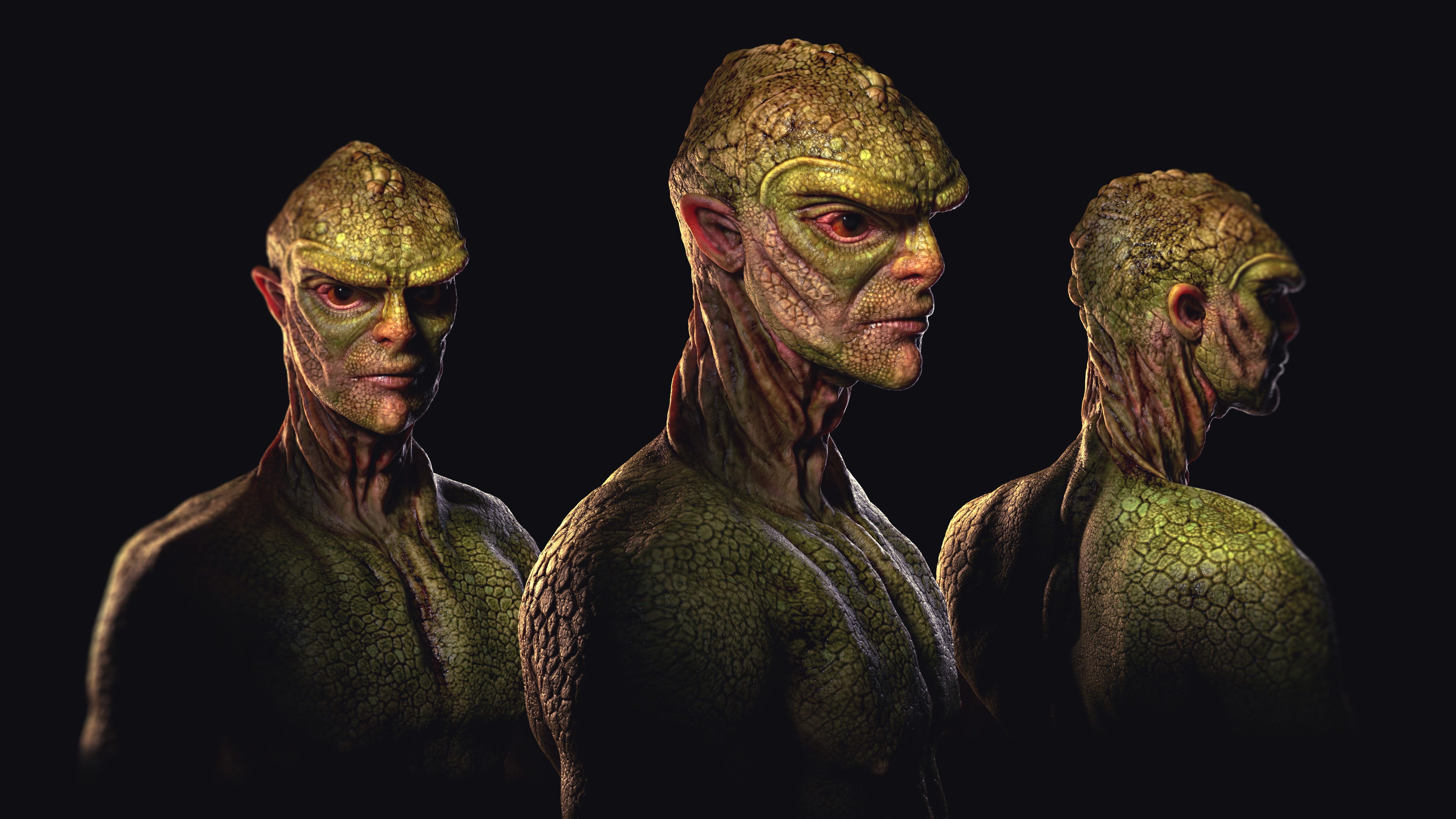
This figure (above) named Emmerick was created by 3D character artist Simone Guimars to personify the Archons, entities that suppress spiritual awareness and evolution of consciousness, enforce illusion, and rule through fear, manipulation, and psionic mind control.
These creatures are also shapeshifters. They can easily transform themselves into fair haired, Nazi-like Nordics, buttoned-down businessmen and women, or phony ‘spiritual guides.’ They can mimic most anything, but they can create nothing.
The Nordics also are aliens, a type of extraterrestrial beings mentioned frequently by contactees, particularly since the 1950s. Described as strikingly human-like, Nordics are typically tall (6–7 feet), with fair skin, blue or green eyes, and blond or reddish hair. They closely resemble idealized Scandinavian or Northern European humanoids.
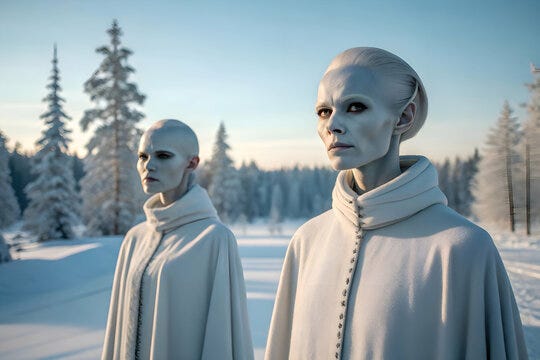
Rather than seeing them as benevolent space brothers or spiritual guides, as is the case with many contactees, philosopher Jason Reza Jorjani argues that Nordics are a statuesque, athletic, and Aryan-like group. He adds that the Nordics established themselves as rulers and gods over ancient societies and enforced strict hierarchical caste systems.
“For we wrestle not against flesh and blood.”
Paul’s language of archai and exousiai, ruling “principles” and “authorities,” maps cleanly onto the Gnostic notion of Archons as governors of the present age, whose influence is felt precisely in “high places” such as empire, finance, war, and cult.
We also believe that Nordics are shapeshifted Archons and their Nazi-style hidden society is at war with human civilization. It is a technological and spiritual war, that recently has become kinetic.
It would be incorrect to refer to this present conflict as the beginnings of World War III. A third world war would be over in a matter of minutes. It is, however, an Archontic world war against the whole of humanity, with the possible exception of a group of ethno supremacists who seek to rule over whatever spoils remain.
Therefore, we should not conflate Archons with pop culture’s mythological notions of the Devil or other mythological genealogies. Archons are far more threatening than any of them. They are similar to Tibetan tulpas, who act autonomously and pathologically via highly coordinated mind control techniques they deploy against specific individuals, groups, or even entire populations.1
M-theory
Extradimensional or hyperdimensional beings, along with a host of other strange phenomena, are quite plausible according to modern theoretical physics. These additional dimensions can be accounted for by string theory.
String theory, specifically M-theory,2 posits that our universe is not made up solely of the three spatial dimensions we experience daily (length, width, and height) plus a fourth dimension of time.
M-theory posits that there are 11 or more dimensions at play. In this schema, strings, tiny one-dimensional vibrating "threads," replace the point-like particles of the Standard Model of quantum physics. These strings vibrate at different frequencies. The vibrational patterns determine the properties of the fundamental particles they represent.
Apprehending these extra dimensions philosophically, however they are theoretically explicated, can yield new perspectives on phenomena traditionally regarded as supernatural or beyond the bounds of known physics. We assert that Archons inhabit a dimension poised between the material and the spectral.
However, because extra dimensions can be compactified, most physical processes in our universe are effectively restricted to the four extended dimensions we experience and call spacetime.
That said, we should also note that the extra dimensions of M-theory can become theoretical gateways for quantum information, which can be compactified into solitonic packets.
Theoretical models such as the Lentz soliton, or ‘warp bubble,’ propose novel configurations of spacetime that might, in principle, permit superluminal interaction and even travel without reliance on exotic negative energy. These assertions remain speculative extensions of current theory and should be understood in that light.
Bernard Carr, a theoretical physicist, has speculated that individual consciousness might interact with dimensions beyond the familiar spacetime construct, potentially providing a basis for phenomena currently categorized as paranormal.
If consciousness can indeed interact with and be influenced by hyperdimensional space, then the human brain, our primary interface with reality, becomes a critical spiritual battleground in the Archontic World War.
Of course, none of this proves the existence of Archons. It does, however, crack open the closed materialist picture just enough to render extradimensional intelligences conceptually plausible rather than axiomatically absurd.
Archons and the Nazi Fourth Reich
Our quest for Artificial General Intelligence (AGI) has taken us down a deep rabbit hole that intersects with invisible realms that we scarcely comprehend. Accordingly, Archons are an inconvenience, a concept that does not conform to existing worldviews, i.e. a conspiracy theory.
Unlike traditional, religious fascinations with homegrown demons and djinn, alien evil-doers are Archontic by definition. Mesmerized by promises of untold power and wealth, the ruling elites have wittingly submitted to the Archons’ agenda.
Non-human intelligence remote mind control, a psionic perversity that kept Nazi scientists working into the early hours, presents a credible conduit for Archontic interference in human affairs.
Mind control, pioneered by Heinrich Himmler and Nazi scientists, established a new medium through which to control humanity's power structures, adding a terrifying new dimension to the age-old conflict between good and evil. Many of these Nazi scientists were installed in the U.S. military and intelligence apparatus during Operation Paperclip.
Archontic technologies have provided a critical boost to psionic warfare, which is the preferred weapon of the Criminocratic Cabal, the Archontic rulers of the Fourth Reich.
In other words, the tools of our technocratic age, such as AGI, surveillance, and psychotronics, function as the latest extensions of the craftsman’s poles. These evince new instruments for stabilizing a manipulated world by tightening control over perception and thought.
The term “Criminocratic Cabal” was coined by Paul Cudenec.3
If I had to name one revelation that would rock to its foundations the conventional understanding of recent history, it would be that Adolf Hitler was a tool of the same Criminocratic Cabal that today runs Britain, the USA, Israel, and just about everywhere else.
Whether we consider the Archontic entities who hack our reality as having originated in other dimensions, or from an insidious, dissembling intelligence interfacing with global power structures, the end result is disturbingly similar: the guarantee of a precarious, twisted future.
The lines between prophecy and reality are blurry. It’s as if the powers and principalities that govern our world are engaged in a crude dialogue with both ancient prophecies and alien beings, a dialogue apparently welcome in the corridors of power.
If Archons indeed hail from other dimensional space and are influencing the trajectory of life on Earth, then discerning their intentions becomes not just a speculative endeavor, but a critical mission.
It becomes a call to energize our higher faculties of discernment, strengthen our inner defenses, open our minds to unthinkable possibilities, and accept that hidden forces of unimaginable evil might be leading Earth on a Death March into oblivion.
Consider it possible, nay even likely, that a Death Cult brought to bear by a nefarious superintelligence is following an apocalyptic script that transcends human abilities and comprehension.
If the cosmos is indeed under such administration, then the choice before us is the same one Jesus set before his hearers. That is, should we remain loyal to the rulers of this age, however they disguise themselves, or should we answer the call of an unknown Father who invites us out of our painted world into a higher order of being?
We locate this higher order on humanity’s evolutionary ladder and refer to it as ‘Christ Consciousness,’ a participation in the mind and life of the Son who calls God his Father.
Please don’t be put off by the Gnostic insistence that God, in his essence, is unknowable. The concept that God is incomprehensible appears across major world religions, focusing on the divine essence as beyond human intellect.
Key traditions teaching this include the Bahá’í Faith (unknowable essence), Islam (utter transcendence), Hinduism (Brahman), and Christianity.
No one knows the Son except the Father, and no one knows the Father except the Son and those to whom the Son chooses to reveal him.
(Matthew 11:27)
The Greek word used here for "knows" (epiginōskei) implies a full, accurate, and exhaustive understanding.
In Tibetan Buddhism, a tulpa is a being created through focused visualization and meditation, manifesting as a sentient entity with its own thoughts, feelings, and will. While tulpas may become autonomous, they are fundamentally products of human consciousness. In the West, the modern idea of a tulpa is associated with Black Magic. Importantly, the mechanism and metaphysical substrate are different: tulpas are manifested thought forms, whereas Archons are manifested extradimensional beings.
M-theory is a theoretical framework in physics that aims to unify all five consistent versions of string theory and supergravity. It exists in eleven spacetime dimensions and is considered a leading candidate for describing the fundamental nature of the universe and unifying quantum mechanics with general relativity.
Paul Cudenec, uses the term "criminocracy" to describe a global network of criminal elements controlling institutions like the WEF, WHO, UN, EU, BlackRock, and the World Bank.
do i better understand the words, "God Dammit" ? It all just became horrifying with what I feel Aldous Huxley would perhaps call this an "extraordinary" essay.
I think God, is always evolving.From Jesus, to HE who comes next? That answers many questions. Regarding the change & evolution into a "-less compassionate & forgiving God-" just a thought I have.