
Loosh
An Essay by Unbekoming

Foreword
Merry Christmas and Happy New Year. Thank you for subscribing to Rational Spirituality.
Beginning in January, I will pivot Rational Spirituality to a more “prophetic” tone. The old world is passing away and the Aquarian Age is fast upon us. The interim period in which we find ourselves is called an interregnum.
Philosopher Antonio Gramsci describes an interregnum as a dangerous period of societal transition in which old orders collapse while new ones have not yet fully formed. This unsettled condition breeds instability, the rise of extremism, and what he termed “morbid symptoms,” such as conflict, chaos, and recurring crises. These conditions evince a world in flux marked by shifting centers of power and political fragmentation.
The Aquarian Age was first proclaimed, ironically at the beginning of the previous Piscean Age, by Jesus as he and his disciples made their journey “up to Jerusalem” to fulfill the climactic events of his earthly mission and make their preparations for Passover.
When you have entered the city, a man carrying a pitcher of water will meet you; follow him into the house he enters.
Luke 22:10
For those of us of a certain age, this verse evokes memories of The Fifth Dimension’s popular hit song, “Age of Aquarius.” The lyrics went: “When the moon is in the seventh house and Jupiter is aligned with Mars…”
In essence, this pop astrology set to music points to a time when personal feeling (the Moon), relationships (the Seventh House), expansive new ideals (Jupiter), and assertive action (Mars) all converge to herald significant relational and cultural breakthroughs.
The “relational breakthrough” alludes to the awakening, or more precisely the remembrance, of our divine essence, the Divine Spark within every human being. It marks a reorientation of consciousness and a shift in how humans relate to existence.
The “cultural breakthrough” suggests a paradigm shift, or new zeitgeist, touching not only science but also religion, economics, culture, and most other aspects of daily life.
These twin breakthroughs will be powered by loosh, the disruptive energies of chaos and change, and a term you may recall from a previous essay of ours on Archons titled The Illuminator of Knowledge.
What follows is a comprehensive essay on the subject of loosh, which we have reproduced here in its entirety. The piece, written for Substack by Unbekoming, examines loosh from both psychological and metaphysical perspectives.
Humanity will emerge from this challenge in a state of higher consciousness presently incomprehensible to us. That is the good news; there will be no Atlantis-scale catastrophe in our immediate future.
On the other hand, the degree of “creative destruction” and consequently loosh that is required to traverse cosmic ages depends upon ourselves, specifically, upon our spiritual maturity and self-awareness.
By understanding what loosh is, how it operates, what entities govern it, and even by simply becoming aware of its existence, we can significantly modulate its destructive mechanisms.
My thanks to our friend Unbekoming for compiling this invaluable and comprehensive essay and explainer!
Loosh
By Unbekoming
I. A Word That Changes Everything
I first encountered the word in Feargus O’Connor Greenwood’s remarkable book 180 Degrees: Unlearn the Lies You’ve Been Taught to Believe. It appeared near the end, in the sections most readers never reach—the territory where comfortable skepticism gives way to something stranger.
The word was loosh.
Greenwood defines it simply: “the slang term for the human emotional psychic energy (in this case negative energy) that is being generated.” He traces it to Robert Monroe, founder of the Monroe Institute and author of Far Journeys, who presents Earth as “a human farm where energy is trawled.”
But Greenwood shows that Monroe was not alone. Carlos Castaneda, in The Eagle’s Gift, records his teacher Don Juan Matus—a Yaqui Indian shaman—describing the same phenomenon in different language:
“We have a predator that came from the depths of the cosmos... they took us over because we are food for them and they squeeze us mercilessly because we are their sustenance.”
The concept reaches further back still, to the Gnostic tradition and its account of the Archons—parasitic entities that feed on human suffering and work to keep humanity trapped in ignorance. Different cultures, different centuries, different vocabularies—but the same unsettling pattern: we are producing something of value, and something is harvesting it.
At the time, I didn’t have language for what the concept stirred in me. The word sat in my mind like a seed, dormant but alive.
It was only later—years later—as my thinking developed, that I began writing about extraction: the systematic transfer of wealth from human bodies and lives to pharmaceutical shareholders, the medical-financial machinery that converts suffering into profit. I documented biological colonialism, the transformation of the middle class into an extraction zone. I traced the genetic paradigm as the final fortress protecting this system, the wall that makes victims blame their own DNA for conditions created by environmental assault.
And then I saw the connection.
Loosh had been there all along, waiting for me to develop the framework that would make its significance visible. Whether Monroe’s account is literally true or “merely” metaphorical, it illuminates something. It provides a lens through which the extraction patterns I had come to understand suddenly appear in sharper focus. The mechanics become visible. The why behind the system reveals itself, even if that why operates at a level we cannot verify.
This essay is not an argument that loosh is real. It is an invitation to consider what becomes visible when we look through this particular lens. As Greenwood puts it: “When you change the way you look at things, the things you look at change.”
Interview with Feargus O’Connor Greenwood
October 14, 2023
II. Someone and the Garden: Monroe’s Strange Allegory
Robert Monroe was not a mystic by training. He was a businessman, a radio broadcasting executive who in 1958 began experiencing spontaneous out-of-body states that would eventually lead him to found the Monroe Institute and pioneer the scientific study of consciousness. His first book, Journeys Out of the Body (1971), documented his early explorations with the detached precision of an engineer encountering anomalous data.
Far Journeys (1985) went further. In it, Monroe recounts receiving what he calls a “rote”—his term for a compressed packet of information that unfolds in consciousness like a file being decompressed. This particular rote arrived during one of his out-of-body explorations, delivered by a being he calls “BB,” and it contained nothing less than an alternative history of Earth and humanity.
The account is strange. It reads like myth rendered in the clinical language of agriculture and resource management. Monroe presents it not as revealed truth but as “hearsay evidence”—information he received that he cannot independently verify but feels compelled to share.
It begins with Someone, Somewhere:
Someone, Somewhere (or both, in millions, or uncountable) requires, likes, needs, values, collects, drinks, eats, or uses as a drug a substance ident Loosh. (Electricity, oil, oxygen, gold, wheat, water, land, old coins, uranium.) This is a rare substance in Somewhere, and those who possess Loosh find it vital for whatever it is used for.
The parenthetical comparisons are Monroe’s—his attempt to translate something ineffable into familiar economic terms. Loosh is a commodity. It has value. It is scarce. And Someone decided to produce it rather than search for it in its natural form.
Faced with this question of Supply and Demand (a universal law of Somewhere), Someone decided to produce it artificially, so to speak, rather than search for it in its “natural” form. He decided to build a Garden and grow Loosh.
What follows is an elaborate allegory of creation—one that maps disturbingly well onto what we know of Earth’s biological history, viewed from an angle we would rather not consider.
“Deities and Demons Drinking from the Milky Pool”
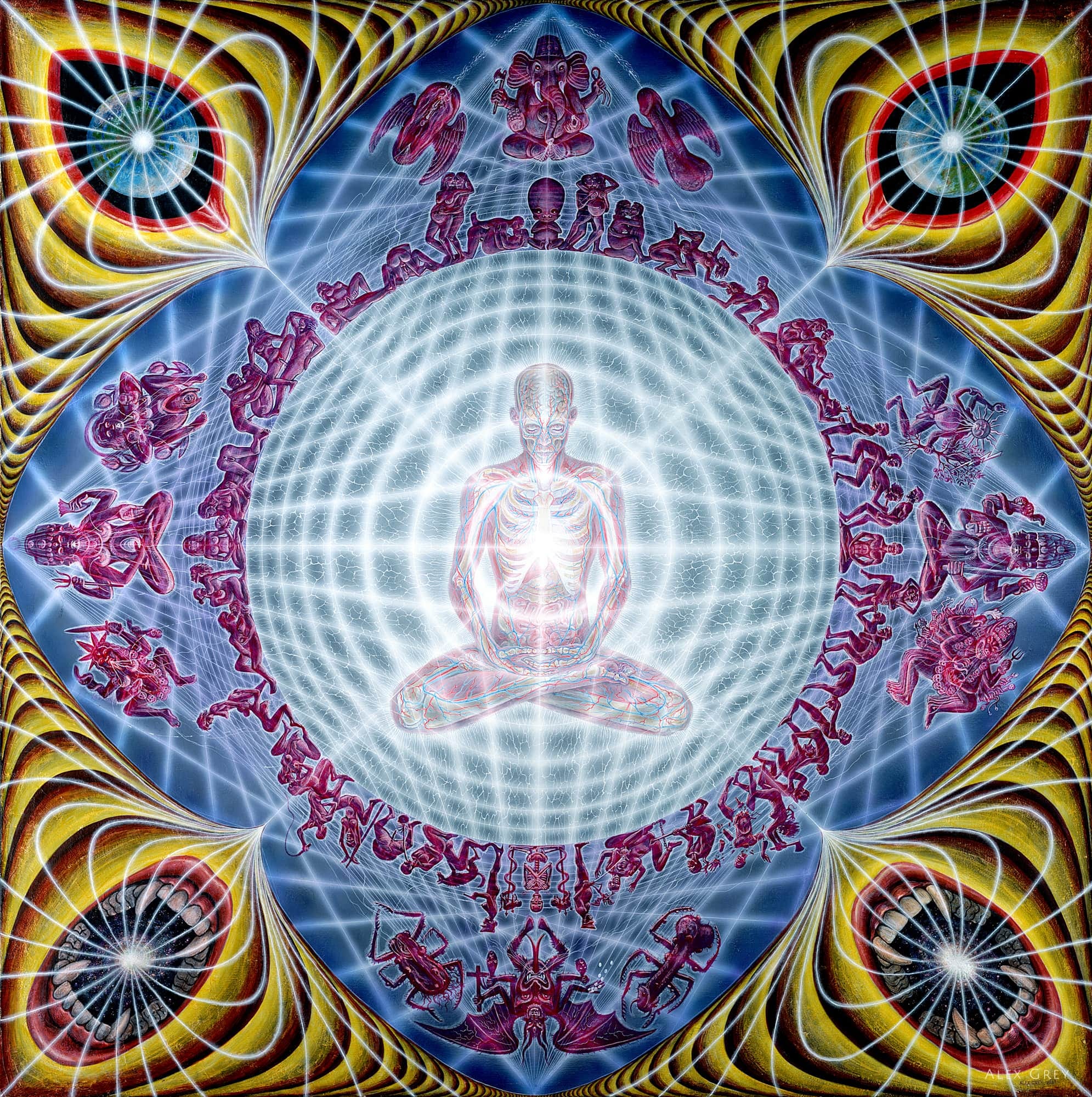
Alex Grey’s painting “Deities and Demons Drinking from the Milky Pool” (1987, acrylic on linen) stems from a profound visionary experience he had during a group psychedelic session. Grey described the vision as follows:
He saw the group soul of humanity as a perfectly circular pool of intense shimmering psychic energy. Translucent Hindu-like deities swooped over the group, absorbing the excess energy from the pool, which manifested as waves of ecstasy and pain passing through the participants. He realized the gathering served as a “psychic energy feast” for gods and goddesses. At the center, he perceived his own heart as an axis uniting polarities—male/female, birth/death, good/evil, love/hate—and understood that to maintain cosmic balance, humanity feeds both deities (divine forces) and demons (darker forces).
The painting visually captures this duality: a symmetrical composition often viewed upside down to emphasize the demonic half, with ethereal beings on one side and more chaotic or infernal figures on the other, all drawing from the central milky pool of human emotional and spiritual energy.
While the work draws broader inspiration from Tibetan Buddhist Dzogchen teachings (emphasizing non-dual awareness and the interplay of mind’s illusions), this specific piece directly channels Grey’s personal mystical insight into how human experiences sustain both light and shadow aspects of existence.
The painting has appeared in various contexts, including as album art for Meshuggah’s 1995 EP Selfcaged, and it has sparked diverse interpretations, some praising its exploration of polarity and others critiquing perceived hierarchies in its symbolic depictions. - SuperGrok
III. The Crops: A History of Optimisation
Monroe’s account proceeds through what he calls “Crops”—successive experiments in loosh production, each more sophisticated than the last.
The First Crop consisted of simple organisms in a liquid environment. They produced loosh, but “only in small quantities and of comparatively low grade, not significant enough to take back to the heart of Somewhere.” The problem was twofold: “The life period was too short and the crop units themselves were too minute.” Moreover, “the Loosh could be harvested only at the moment of termination of the life span, not one moment before.”
This is unicellular life. Loosh released only at death, in tiny amounts.
The Second Crop was larger and more complex—plants, essentially. Someone “planted numberless units in many varieties in a new form, with a great increase in size, some many thousands of times larger and more complex than the simple unicellular First Crop.” To prevent uneven distribution, “he immobilized the Second Crop. Each was designed to stay principally in its own section of the Garden.” Roots, stems, leaves. Photosynthesis. “Brilliant color radiators accompanied by small particle generators were mounted on each unit”—flowers.
Someone discovered that violent weather could harvest loosh from these stationary crops: “If the turbulence were violent enough, the Crop would be blown down, the life span terminated, and the Loosh would discharge.”
But the Second Crop remained unsatisfactory. “While it was true that a much greater quantity was attained, the unrefined Loosh produced was of such low grade that it was scarcely worth the effort.”
The Third Crop restored mobility. Someone “modified and expanded them into a multitude of shapes and sizes, gave them complex multicellular structures of high mobility.” These were the great animals—dinosaurs, in our understanding. “Monstrous and slow-moving Mobiles” with “a life span far out of proportion to their nourishment input.”
And then came the accident that changed everything.
As the Second Crop (plants) grew scarce, “energy needs of the Mobiles became acute. Often two Mobiles would seek to ingest the identical Second Crop unit. This created Conflict, which resulted in physical struggle among two or more of the ungainly Mobiles.”
Someone observed these struggles “at first bemused with the problem, then with great interest. As the struggles ensued, the Mobiles were emanating Loosh! Not in fractional amounts, but in sizable, usable quantities and of a much higher purity.”
Here is Monroe’s Prime Catalyst, rendered in his strange clinical language:
Thus it was that the Rule of the Prime Catalyst came into being. Conflict among carbon-oxygen cycle units brings forth consistent emanations of Loosh. It was as simple as that.
Conflict produces energy. Struggle releases loosh. The implications radiate outward.
IV. The Fourth Crop and the Piece of Someone
Satisfied with his discovery, Someone prepared the Fourth Crop—smaller, faster animals designed for conflict. “He created them in literally thousands of original types, small, large—yet none so large as the Third Crop Mobiles—and ingeniously gave each some appurtenance for conflict.” Teeth, claws, speed, camouflage, venom. “All of the latter served neatly to add to and prolong the conflict periods, with the resultant increase in Loosh emanation.”
The dinosaurs were terminated. The new ecology emerged—predator and prey in endless cycles, loosh flowing steadily from the Garden to Somewhere.
But Someone conducted one more experiment. He created “one form of Mobile that was weak and ineffective by the standards of the other Mobiles in the Fourth Crop.” This experimental unit had two advantages: it could eat both plants and animals, and it contained something unprecedented.
Someone pulled forth a Piece of Himself—no other source of such Substance being known or available—to act as an intensive, ultimate trigger to mobility. Following the Rule of Attraction, Someone knew that such infusion would create in this particular Mobile species an unceasing mobility. Always, it would seek to satisfy the attraction this tiny mote of Himself engendered as it sought reunion with the infinite Whole.
This is humanity in Monroe’s account—a weak animal carrying a fragment of the divine, forever restless, forever seeking something it cannot name, driven by a longing that can never be satisfied within the Garden.
Thus the drive for satisfaction of energy requirements through ingestion would not be the only motivating force. More important, the needs and compulsions created by the Piece of Someone could not be satiated throughout the Garden. Thus the need for mobility would be ever-present and the conflict between this need and that of energy replacement would be constant—possibly a continuous high-order Loosh emanator if it survived.
The Fourth Crop “exceeded all of Someone’s expectations.” Loosh production reached levels requiring infrastructure:
To handle the output, Someone set up Special Collectors to aid in the harvest. He set up Channels to convey the raw Loosh from his Garden to Somewhere. No longer did Somewhere depend principally upon the “wild state” as the principal source of Loosh. The Garden of Someone had ended that.
V. The Discovery of Distilled Loosh
The Garden might have continued indefinitely in this state—conflict, death, harvest, repeat—had Someone not noticed something unexpected in a routine sample.
On a particular analysis of a Loosh sample, Someone had casually examined the emanations and was about to return it to the Reservoir—when he became aware of a Difference. It was very slight, but there it was.
Woven into the common loosh was “a slender fragment of purified and distilled Loosh.” This was impossible. Distilled loosh required extensive processing. Raw loosh from the Garden should not contain it.
Someone returned to investigate. The source was not the First or Second Crop. It came from the Fourth Crop—specifically, from one of the experimental units containing the Piece of Himself.
The flash came during the unusual action of this unit as it entered into a life-terminating struggle with another Fourth Crop unit. This alone would not create distilled Loosh, Someone knew, and he probed deeper for the source.
The animal was not fighting over food. It was not fleeing predation. It was not defending territory.
It was in Conflict to protect and save from life termination three of its own newly generated species huddled under a large Second Crop unit waiting for the outcome. There was no doubt about it. This was the action that produced the flashes of distilled Loosh.
A parent defending children. Self-sacrifice. Something operating “above the sensory bounds of the environment”—beyond mere survival instinct.
But this wasn’t the only source. Someone extended his perception across the Garden and found an even more potent emanation:
There it was—an experimental Modified Fourth Crop unit, one of those that contained a Piece of Himself in its functional pattern. It was standing alone under the leafy upper portion of a large Second Crop unit. It was not “hungry.” It was not in Conflict with another Fourth Crop unit. It was not acting in defense of its “young.” Then why did it emanate distilled Loosh in such great quantity?
Someone moved closer. His perception entered into the Modified Fourth Crop unit and then he knew. The unit was lonely! It was this effect that produced distilled Loosh.
Loneliness. Longing. The ache of incompleteness.
The being became aware of Someone’s presence. “It had collapsed and was jerking in strange convulsions on the solid-base formation. Clear liquid was being expelled from the two radiation-perceiving orifices.” Tears. “With this, the distilled Loosh emitted became even more pronounced.”
From this discovery, Someone formulated what Monroe calls the DLP (Distilled Loosh Production) Formula:
The creation of pure, distilled Loosh is brought forth in Type 4M units by the action of unfulfillment, but only if such pattern is enacted at a vibratory level above the sensory bounds of the environment. The greater the intensity of said pattern, the greater the output of Loosh distillate.
The formula was implemented. “The splitting of all Crop units into Halves (to engender loneliness as they sought to reunite)” was one innovation—the creation of biological sex, the eternal search for the other half. Humanity was encouraged to dominate the Garden.
And the Collectors developed “an entire technology with complementary tools for the harvesting of Loosh from the Type 4M units”:
The most common have been named love, friendship, family, greed, hate, pain, guilt, disease, pride, ambition, ownership, possession, sacrifice—and on a larger scale, nations, provincialism, wars, famine, religion, machines, freedom, industry, trade, to list a few. Loosh production is higher than ever before.
Read that list again. Every human institution, every emotion, every structure of meaning—reframed as harvesting technology. Tools for extraction.
VI. Monroe’s Crisis
Monroe did not receive this rote with equanimity. His response mirrors the stages of grief:
It took me several months to adjust to the loosh rote. “Adjust” is a very broad word to describe a complete cycle of shock, rejection, anger, depression, resignation, acceptance. My sequence paralleled remarkably the pattern others have discovered and studies as to human response when notified of approaching death from illness or injury.
Something was dying in me.
What died was a certain comfortable relationship with existence:
The loosh rote explained everything very neatly. Most important, it explained the purpose, the reason for it all, the why of it. This factor had long eluded me. The loosh answer was simple and obvious. The reason was there, in very prosaic fashion. We were indeed producing Something of Value.
The food chain suddenly appeared in a new light. “Knowing this about Mother Nature, some of the hard-core philosophic speculators had often pondered where the human animal fit in the process. The downside was obvious, who ate us! Before, it had been just that, speculation. Now...”
Monroe wrote a meditation that captures the existential weight of the revelation—the parable of the Guernsey cow:
It is sunset. The Guernsey has walked many miles around the pasture in her forage for food. The grass had been more lush today here, though she did not bother to consider why...
But now, at sunset, it is time again. She must go to His place. There is a goading pain on her underside that tells her this. At His place up on the hill, it is cool and there is more food. And He will take the pain away.
The Guernsey moves up the hill and waits beside His place. Soon, the gate will open and she will walk into her position in His place, and eat the grass He places before her. While she eats, He will relieve the pain until morning.
After that, the Man will walk away with white water in a round container. The Guernsey does not know where he got the white water nor why He desires it.
Not knowing, she doesn’t care.
The parable captures something essential: the cow’s relationship to the farmer is not adversarial. She receives grass, protection, relief from pain. She doesn’t understand the larger system, and her not-understanding is part of what makes the system work.
Monroe asked himself what would happen if the cow did understand:
What would happen if the Guernsey cow did discover that her milk had value? What could she herself do with it if she didn’t have a calf to feed it to? Could she save it? Could she spend it on more hay or protein-vitamin blocks to lick? What if she then discovered man was taking the milk she produced? Rebel, refuse to deliver any more milk? Then she would no longer have a pasture in which to graze, protection from wild dogs, a bull when she needed it, and most of all, no barn to go to where she could get relief from the pain.
Therefore: Who cares? Who would care!
This is the trap. The extraction system provides enough benefit that rebellion seems irrational. The cow who refuses to give milk loses everything. Better not to know. Better not to look.
VII. The Reframing: Love as Loosh
Monroe did not remain in despair. He eventually confronted the beings he called INSPECs (Intelligent Species)—entities he had encountered throughout his explorations who seemed benevolent but whose role in the loosh economy remained unclear.
Were they the gardeners? The collectors? The overseers?
Their answer reframed everything:
We are not Someone, as you put it, nor are we from the Somewhere you indicate. Also, we are not the keepers of the Garden of Earth, nor the gardeners. Nor do we collect and transfer human-developed loosh/energy elsewhere or when. We do not fit into any portion of the human compressed learning process. However, we have observed its generation and growth from its inception.
The INSPECs were not part of the extraction apparatus. They were something else—observers, assistants, beings who participated “when needed without interrupting the learning sequence.”
But more importantly, they clarified the nature of loosh itself. When Monroe reviewed his own life, scanning for loosh production, he searched for “white surges”—the color he associated with the highest-grade emanation. He found them scattered through his history, often where he hadn’t expected:
Loosh, an energy generated by all organic life in varying degrees of purity, the clearest and most potent coming from humans—engendered by human activity which triggers emotion, the highest of such emotions being—love? Is love loosh?
The INSPEC responded:
(Continue, Ashaneen.)
Monroe pressed further:
But according to the rote, loosh is thrown off when life ends its physical existence, when pain occurs, anger, hate... these can’t be the same as love.
The answer reframed the entire paradigm:
(How would you define love in your terms?)
Monroe couldn’t answer. But the implication was clear. The loosh extracted through conflict and suffering was crude, low-grade. The distilled loosh—the premium product—came from states that transcended survival: parental sacrifice, longing, love itself.
Here is where Monroe’s original account diverges significantly from how loosh is often presented. Greenwood and others who have developed the concept tend to emphasize the negative—fear, anxiety, hatred as the substance being harvested. This framing casts the harvesting operation as purely parasitic, predatory, malevolent.
Monroe’s account is stranger and more unsettling precisely because it’s more complex. Yes, the system harvests suffering. Conflict was the Prime Catalyst, the accidental discovery that revolutionized loosh production. But the highest-grade product isn’t suffering at all—it’s love. The being weeping alone under a tree produced more distilled loosh than all the predation and conflict combined.
What does this mean? It could mean the system is even more insidious than a simple horror story—that it has found ways to harvest even our highest states. Or it could mean something else entirely: that the suffering is a byproduct, a crude early method, and the system’s true purpose involves cultivating something we would not entirely condemn if we understood it.
The system was not simply feeding on human misery. It was—at its highest function—cultivating human love. The suffering was a byproduct, or perhaps a catalyst. The real harvest was something else.
Monroe came to see Earth as “a carefully designed school of compressed learning”—a place where beings learn “to express anger, pain, fear, and all the rest, and finally—hopefully, if you passed the course—a special energy waveform labeled love.”
To learn to be high-quality loosh/love producers.
This doesn’t make the extraction benign. The suffering remains real. The unconsciousness remains problematic. But it suggests a larger frame—one where humanity is not simply prey but participants in something we don’t fully understand.
The INSPEC beings eventually took Monroe to the edge of “Somewhere”—the destination of all that harvested loosh/love. What he perceived there overwhelmed him:
Even closed tightly, the radiation was so strong that it was nearly unbearable... I felt as if sweat were pouring off me, I was melting... but it wasn’t heat... and I began to heave with great racking sobs and I couldn’t understand why...
What he saw, shielded by his INSPEC guide, was a radiant form of “incredible size”—beings emanating and receiving the energy that flowed from countless gardens like Earth. The loosh/love was going somewhere, for some purpose, to Someone who had created the system and seeded it with pieces of Himself.
VIII. From Metaphysics to Clinic: Jerry Marzinsky’s Discovery
If Monroe’s account seems too strange, too removed from verifiable experience, consider the work of Jerry Marzinsky—a licensed psychotherapist who spent over forty years working with paranoid schizophrenic patients in psychiatric institutions and prisons across America.
Greenwood’s book first alerted me to Marzinsky’s research. My curiosity led me to contact Jerry directly, and I’m grateful that he agreed to an interview. I wanted to hear it in his own words—the journey that had taken a complete skeptic, trained in conventional psychiatry, to conclusions that would overturn everything he had been taught.
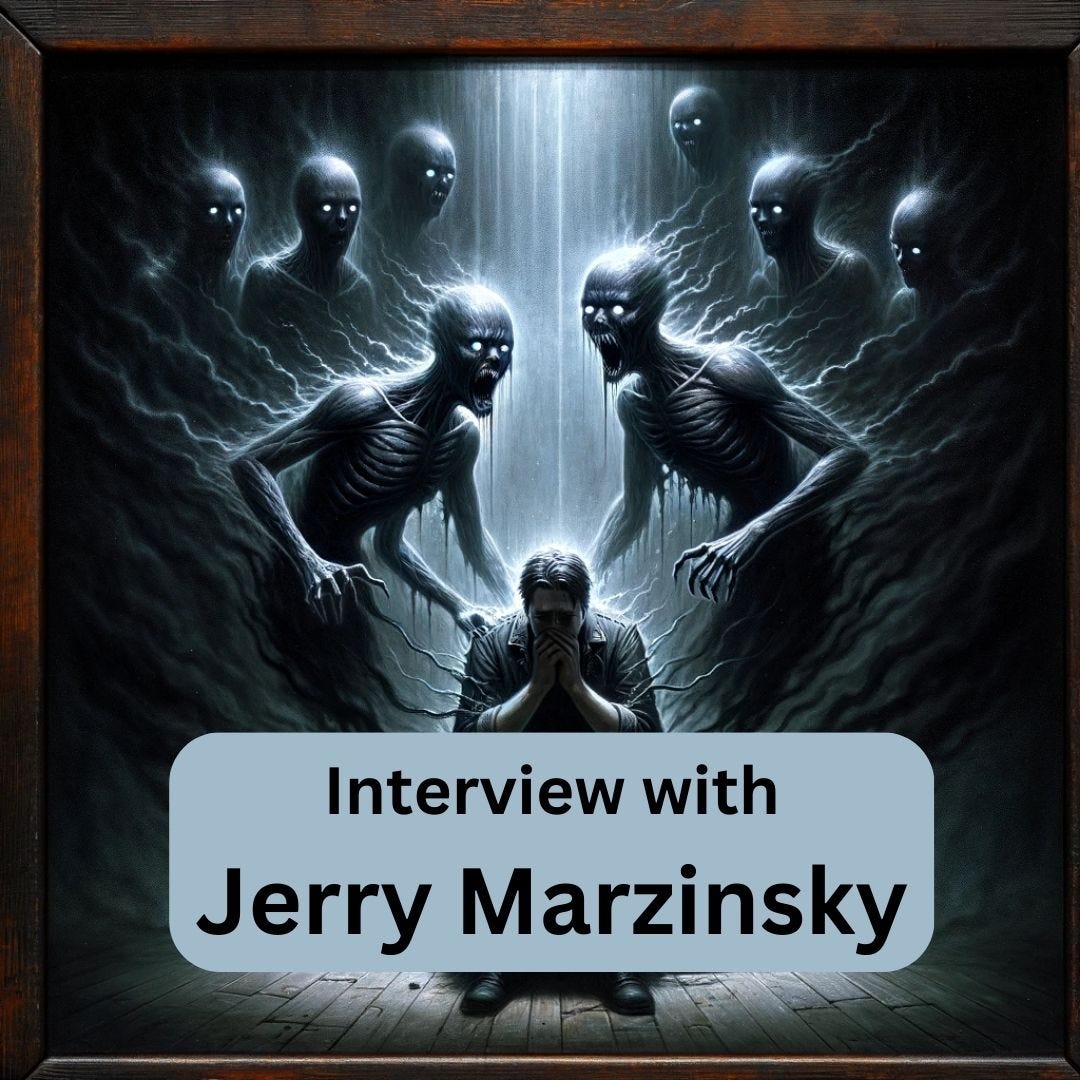
Interview with Jerry Marzinsky
May 18, 2024
What struck me most was his insistence that this phenomenon isn’t limited to diagnosed schizophrenics. As he told me: “These negative entities are around us all the time. They don’t just hit schizophrenics, they hit us all inserting negative, destructive ideas into our thought streams and urging us to act on them. Everyone has had shocking intrusive thoughts telling them to do something they would never voluntarily do.”
The difference with schizophrenics is one of degree, not kind. They are simply more heavily targeted—and more visibly affected—than the rest of us.
Marzinsky began as a complete skeptic. His training taught him that the voices schizophrenics hear are hallucinations—random neurological misfirings, symptoms to be suppressed with medication. The biochemical imbalance theory. The DSM categories. The pharmaceutical protocols.
But something didn’t fit.
“When I started work at what might well have been the largest psychiatric hospital on the planet, Central State in Georgia,” Marzinsky recalls, “surprisingly that was not what I saw. Schizophrenic patients were walking around carrying on coherent conversations with whatever their voices were, at times breaking out into full-fledged arguments with them.”
The voices weren’t word salad. They spoke in complete sentences. They had intent. And over decades of careful observation—interviewing hundreds of patients across multiple institutions—Marzinsky discovered something that should have revolutionized psychiatry:
The voices run patterns.
Not random patterns. Fixed, repeatable, predictable patterns—the same patterns in Georgia as in Arizona, the same patterns in prisons as in hospitals, the same patterns across decades and demographics.
“Hallucinations do not run patterns,” Marzinsky emphasizes. “Hallucinations are random; they do not run fixed, unyielding patterns.”
What are those patterns? Here is a partial list from Marzinsky’s research:
Negativity: The voices are consistently negative, derogatory, insulting, abusive. They may pose as helpers initially, but they invariably turn destructive once they gain trust.
Anti-Religious: They resist their victim attending church, reading scripture, or following any positive spiritual path. “One patient reported the voices reacted to the repetition of the 23rd Psalm like worms thrown onto a hot frying pan.”
Foster Negative Emotion: The voices work systematically to create and prolong negative emotional states—anger, anxiety, paranoia, guilt, shame.
Energy Drainage: After attacks, patients report severe energetic depletion. “After these attacks, victims report feeling as tired and lethargic as if they have been digging ditches in the hot sun all day. This is despite the fact that they had not done any significant physical work.”
Demand Attention: The voices constantly maneuver to capture and control the victim’s attention.
Foster Isolation: They work to destroy marriages, friendships, family relationships—eliminating anyone who might help the victim.
Complete Memory Access: The voices have total access to the victim’s memory, using it to dredge up guilt and shame.
Consummate Liars: They cannot be trusted. They make promises they never keep. One patient was told that if he poked out an eye, the voices would leave. After he did so, they returned to mock him.
Disguise as Victim’s Thoughts: When patients ask “Who are you?”, the answer is always the same: “We are you.”
This last point is crucial. The voices operate by passing themselves off as the victim’s own thoughts. The victim believes these are their thoughts, acts on them, and spirals deeper into dysfunction.
Marzinsky’s conclusion, arrived at through decades of clinical observation:
There is no difference between the voices and what would be considered demons or evil spirits. They hate the human race and are doing everything possible to destroy us.
He describes a pivotal moment:
At one point I had a schizophrenic prisoner I was working with come to my office in the psychology department reporting that the voices told him to come and that they wanted to speak to me personally. I escorted him in then closed the door and asked what his voices had to say. These words came out of his mouth from the voices: “You have no right to interfere with OUR way of life.”
Our way of life. Not a hallucination—an entity with interests, annoyed at interference with its feeding.
IX. The Clinical Extraction Protocol
Look again at Marzinsky’s patterns. They describe an extraction operation.
The voices create negative emotional states. They feed on the energy generated. They drain their victims. They isolate victims from help. They disguise themselves as the victim’s own thoughts. They operate through established technology—psychological manipulation, gaslighting, memory access, emotional triggering.
This is loosh harvesting at the individual level. The same pattern Monroe described operating cosmologically, Marzinsky observed operating clinically.
And the countermeasures align precisely. Monroe’s account emphasizes that love is the highest-grade loosh, that positive spiritual states are fundamentally different from negative ones. Marzinsky found that prayer, scripture, and positive spiritual practice cause the voices to retreat. “They can’t stand their victim going to church or reading the Bible. What kind of hallucination would hate the Bible?”
The question answers itself.
Marzinsky’s work also reveals something about how these entities gain access:
There appears to be a significant correlation between severe physical, mental and sexual abuse and the appearance of these entities or evil spirits. They go after those most damaged as they are easier targets. I’ve rarely seen a schizophrenic who has not suffered some sort of extreme abuse.
Trauma as entry point. Damage as vulnerability. This connects to everything we know about cycles of abuse, intergenerational trauma, and the compounding nature of suffering.
X. Institutional Loosh: The Extraction at Scale
Now widen the lens.
Monroe’s Collectors developed “an entire technology” for harvesting loosh, including: love, friendship, family, greed, hate, pain, guilt, disease, pride, ambition, ownership, possession, sacrifice—and on a larger scale—nations, provincialism, wars, famine, religion, machines, freedom, industry, trade.
Consider modern medicine through this lens.
In my essay on biological colonialism, I documented how the pharmaceutical industry has transformed the middle class into an extraction zone. A woman in Orange County with accumulated wealth of two million dollars—retirement accounts, home equity, savings. Convince her to accept an injection that triggers autoimmune dysfunction, and you initiate a wealth transfer worth millions. Specialists, tests, medications, procedures. Each intervention creates conditions for further intervention. Assets liquidate in sequence. The extraction continues until death.
In my essay on genetics as the fifth wall, I documented how genetic determinism serves every major power structure simultaneously. Politicians escape responsibility. Corporations avoid liability. Pharmaceutical companies gain new markets. When your disease is “in your DNA,” no one is accountable. You were simply born broken, and only the medical system can manage your predetermined decline.
These are extraction systems. They operate through trusted institutions, captured regulators, epistemic control over medical knowledge itself. They convert human suffering into revenue streams. They create conditions that generate more suffering, more intervention, more extraction.
What if they are also loosh harvesting operations?
Not metaphorically. Operationally.
The same patterns Marzinsky observed in schizophrenic patients—negativity, fear generation, energy drainage, isolation, disguise as the victim’s own thoughts—appear at civilizational scale in our medical-financial-governmental systems.
The mainstream media runs the same patterns as the psychotic voices. Constant negativity. Fear generation. Division. Isolation from those who might help. And always disguised as information, as news, as your own informed opinion.
The healthcare system creates chronic patients who believe their bodies are fundamentally defective. The genetic paradigm tells them it’s in their DNA—their own cells are the enemy. Lifetime management. Recurring interventions. The perfect dependent: “a patient who believes their body is fundamentally defective, who accepts that decline is written in their cells, who sees the medical system as their only hope.”
The extraction never stops because the conditions that generate extraction are continuously recreated.
Someone’s Garden is a fascinating spectacle of efficiency.
XI. The Cow Who Knows
What changes when the Guernsey cow understands?
This is the question Monroe couldn’t fully answer. The cow who refuses to give milk loses her pasture, her protection, her relief from pain. The system is designed to make rebellion irrational.
But something shifts when consciousness enters the equation.
Monroe asked his INSPEC guides what happens to those who “beat the machine”—the exceptions, the anomalies. Their answer was cryptic but suggestive: consciousness itself is part of the product. “The fact that human physical consciousness was for the most part totally unaware of being involved in the process may be an important ingredient itself.”
Unconscious extraction produces one grade of loosh. Conscious participation might produce another.
Marzinsky found that awareness was the first step in breaking the voices’ power. Patients who understood that the thoughts weren’t theirs—that an external force was inserting negativity into their thought stream—could begin to resist. The rubber band on the wrist, snapped hard, “stuns the voices into a short temporary silence allowing space for the victim to repeat the 23rd Psalm or implement procedures designed to weaken and short-circuit the voices.”
Recognition creates space. Space allows choice.
The extraction systems I’ve documented—biological colonialism, epistemic capture, genetic determinism—all depend on invisibility. They work because we don’t see them. The colonized beg for their colonization because they believe they’re being saved.
When the pattern becomes visible, something shifts. Not everything—the power differential remains, the infrastructure persists, the extraction continues for those who don’t see. But for those who do see, new possibilities emerge.
Monroe eventually reached what he called “loosh/love”—the recognition that the highest-grade product of the Garden wasn’t suffering but something that transcended suffering. The system might harvest both, but they weren’t equivalent. Fear and love both produce energy, but not the same energy.
This suggests a strategy that isn’t rebellion but transformation. Greenwood quotes a Buddhist principle: “Even peace-loving Buddhists don’t teach that you should never kill—just that you should never kill in anger.” Action without the negative emotional charge. Defense without hatred. The Dalai Lama: “If someone has a gun and is trying to kill you, it would be reasonable to shoot back with your own gun.”
What if resistance to extraction doesn’t require generating more loosh for the extractors? What if the recognition itself begins to change the equation?
XII. What Becomes Visible
I said at the beginning that this essay wouldn’t argue loosh is real. It would invite consideration of what becomes visible through the lens.
Here is what I see:
The same patterns operate at every level—individual consciousness (Marzinsky’s clinical observations), collective systems (biological colonialism, epistemic capture), and cosmic narrative (Monroe’s Garden). Negativity, fear, conflict, energy drainage, disguise, isolation. The technology of extraction.
The same countermeasures appear at every level. Awareness. Recognition. Positive spiritual states. Connection to something beyond the self. The technology of liberation.
Whether these patterns reflect a literal metaphysical reality or a deep structural truth about consciousness and power, they illuminate something. They make visible what prefers to remain invisible.
The medical system that converts suffering into shareholder value. The genetic paradigm that makes you blame your own DNA. The media environment that cultivates fear and division. The financial structures that drain accumulated wealth into institutional coffers. The psychological operations that make resistance seem irrational.
All of it optimized for extraction. All of it producing something of value—for someone.
Monroe called Earth “a carefully designed school of compressed learning.” The curriculum is brutal. The tuition is paid in suffering. But the graduation—if there is one—involves learning something about love that apparently cannot be learned any other way.
The Guernsey cow who discovers her milk has value faces a choice the unconscious cow never confronts. She may choose to keep giving milk—but now as a participant rather than a resource. She may choose differently. Either way, she is no longer simply consumed.
XIII. The Recognition
Something was dying in Monroe when he received the loosh rote. Something may be dying in you as you read this.
Let it die.
What replaces it is not despair but clarity. The extraction is real—whether it operates only at the material level I’ve documented, or whether it extends into dimensions Monroe explored. The patterns are consistent. The evidence converges.
But recognition is not paralysis. The walls of the extraction system are not as solid as they appear. Each one falls to evidence, and the evidence is available to anyone willing to examine it.
The loosh framework suggests that consciousness itself is the variable. Unconscious suffering produces crude extraction. Conscious engagement produces something else. What that something else might be—whether it serves the same harvesters or transcends them entirely—remains an open question.
I think of Monroe at the edge of Somewhere, sobbing uncontrollably in the presence of something he couldn’t fully perceive, protected by a guide from radiation that would have shattered him. He touched one of the rays extending from that radiant source and knew something he would forget because “what I was could not yet handle the reality of it.”
Whatever loosh is, whatever Someone wants with it, whatever the purpose of this Garden called Earth—something in us can touch the source and return changed.
The Guernsey cow who knows is still a cow. She still has udders that fill with milk, still feels the pressure that drives her to the barn. But she is no longer only a cow.
She is a cow who knows.
That may not be freedom. But it is the beginning of freedom.
And in a Garden designed for extraction, the beginning of freedom is no small thing.
References
Primary Sources
Monroe, Robert A. Far Journeys. New York: Doubleday, 1985.
Monroe, Robert A. Journeys Out of the Body. New York: Doubleday, 1971.
Secondary Sources
Greenwood, Feargus O’Connor. 180 Degrees: Unlearn the Lies You’ve Been Taught to Believe. Self-published, 2021.
Marzinsky, Jerry, and Sherry Swiney. An Amazing Journey Into The Psychotic Mind: Breaking The Spell Of The Ivory Tower. Engineering Sanity, 2019.
Marzinsky, Jerry. “Interview with Unbekoming.” Lies are Unbekoming (Substack), May 18, 2024.
Related Works
Castaneda, Carlos. The Eagle’s Gift. New York: Simon & Schuster, 1981.
Swedenborg, Emanuel. Heaven and Hell. 1758.
Wickland, Carl. Thirty Years Among the Dead. Los Angeles: National Psychological Institute, 1924.
Author’s Previous Essays
“Extraction: The Middle Class as Colony.” Lies are Unbekoming (Substack), November 29, 2025.
“The Fifth Wall: Genetics as the Final Fortress of Medical Extraction.” Lies are Unbekoming (Substack), December 20, 2025.
New Biology Clinic
For those of you looking for practitioners who actually understand terrain medicine and the principles we explore here, I want to share something valuable. Dr. Tom Cowan—whose books and podcasts have shaped much of my own thinking about health—has created the New Biology Clinic, a virtual practice staffed by wellness specialists who operate from the same foundational understanding. This isn’t about symptom suppression or the conventional model. It’s about personalized guidance rooted in how living systems actually work. The clinic offers individual and family memberships that include not just private consults, but group sessions covering movement, nutrition, breathwork, biofield tuning, and more. Everything is virtual, making it accessible wherever you are. If you’ve been searching for practitioners who won’t look at you blankly when you mention structured water or the importance of the extracellular matrix, this is worth exploring. Use discount code “Unbekoming” to get $100 off the member activation fee. You can learn more and sign up at newbiologyclinic.com.
Our thanks again to Unbekoming for granting Rational Spirituality permission to present his essay to our readers in its entirety!

Very interesting, Toney! I've always considered schizophrenics as 'antennae' of sorts, and that they were being tormented by outside energies.
Something in me is definitely dying.